
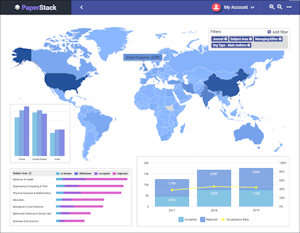
The world of scholarly publishing is an increasingly demanding one, due to key trends such as the shift towards open access, the growth of AI, and rapidly increasing volumes of research. This month we look at some of the key challenges faced by journals publishers, and how DataSalon’s PaperStack service can help you meet those challenges.
Transitioning to open access: Open access mandates usually include a host of reporting requirements. Each funder record in PaperStack links to a complete list of articles they have funded, and all relevant reports can be filtered by funder. This information is all downloadable, making it easy to share with funders.
Ensuring diversity: Journal publishing is now very much a global enterprise, with increasing inter-country collaboration and funding of research by international bodies – understanding and promoting geographical diversity of authors and reviewers is important in ensuring full coverage of research, increasing a journal’s impact, and ensuring that its contributors reflect its readership. PaperStack includes reports on the geographical location of authors and reviewers, with the option to view in map form in order to highlight hotspots and weak areas.
Dealing with the sheer volume of content: A rapid growth in the number of articles published has been fuelled by factors such as increased global collaboration and pressure on academics to prove their value by publishing. PaperStack can handle information about millions of articles, authors, reviewers, affiliated institutions and funders, and by collecting all this into a single repository makes it possible for a publisher to navigate their way through their whole journals portfolio with ease.
Maximizing efficiency: With such a large volume of content, a streamlined submissions workflow is essential. PaperStack has various reports to help you assess efficiency, including tracking of decision times and a flow diagram giving an accurate overall snapshot of the submissions process, as well as an optional KPI module for tracking progress against your yearly objectives. The interactive nature of the charts means that you can click through to any problem articles to explore the reasons behind the headline figures and work out how any issues can be addressed.
Improving the peer review process: An effective peer review process has become even more important with the current proliferation of manuscripts. Because PaperStack covers all of a publisher’s journals, it allows benchmarking of performance (e.g. average number of revisions) against other journals in the same subject area. Reviewer ‘scorecards’ give a handy summary of past performance on all journals – valuable information for an editor who has not themselves worked with that reviewer. And the optional rejected article tracking module shows if valuable articles are consistently being overlooked by particular reviewers.
To discuss the particular challenges you’re facing and find out more about how PaperStack can support you in dealing with them, please get in touch for a chat with our Client Services Director.
 The DataSalon Blog